
Austin & Central Texas
Custom tiled shower pans, built on site.
Not a moulded base from a store. We form a seamless fiberglass membrane to your exact layout. Then your tile goes on top of it.
What you get
One continuous layer, no joints to fail.
A pan liner is a sheet folded into a box and taped at the corners. Every fold, lap and clamping-ring penetration is a place water can eventually find. We bond a single continuous layer of fiberglass to the substrate instead: up the walls, around the drain, over the curb and across the bench in one piece.
The details that fail on most installations are the same ones every time: the corner folds, the curb, the bench, the drain flange, and the transition where the pan meets the wall. On a seamless pan none of those is a joint. The same membrane on decks and balconies →
Where it matters most
Curbless entries and linear drains.
Curbless
A curbless entry means the waterproofing has to run out past the opening and die into the surrounding floor with nothing to stop water at the threshold. There is no curb doing the work, so the membrane is the only thing between the shower and the rest of the room.
Linear drains
A liner has to be folded around a linear drain, which is exactly the shape it is worst at. There is no liner here, so the detail that is normally a headache becomes straightforward. The membrane is simply formed to the trough.
About the pre-slope
The substrate is sloped first. Then the membrane goes over it.
You will read online that fiberglass pans get laid flat, so water sits underneath with nowhere to go. Laid flat, that is a real failure mode. It is also not what the code allows.
The plumbing code requires the substrate beneath the waterproofing to fall a quarter of an inch per foot toward the drain. That slope goes in first; the membrane is formed over it and run up the walls in one continuous piece, so water reaching the membrane runs to the drain rather than standing on it. If someone tells you a fiberglass pan cannot be pre-sloped, ask to see photographs of theirs.
Before it is handed over
We fill it with water and walk away.
The plumbing code test is specific: the drain is plugged watertight, the pan is filled with water to at least two inches measured at the threshold, held for at least fifteen minutes, and checked for any evidence of leakage.
It is the only way to know a pan holds before it is buried under tile. On jobs where it applies, that test is the last thing done before the shower is handed over to you or your tile setter. What the warranty covers →
From the job book
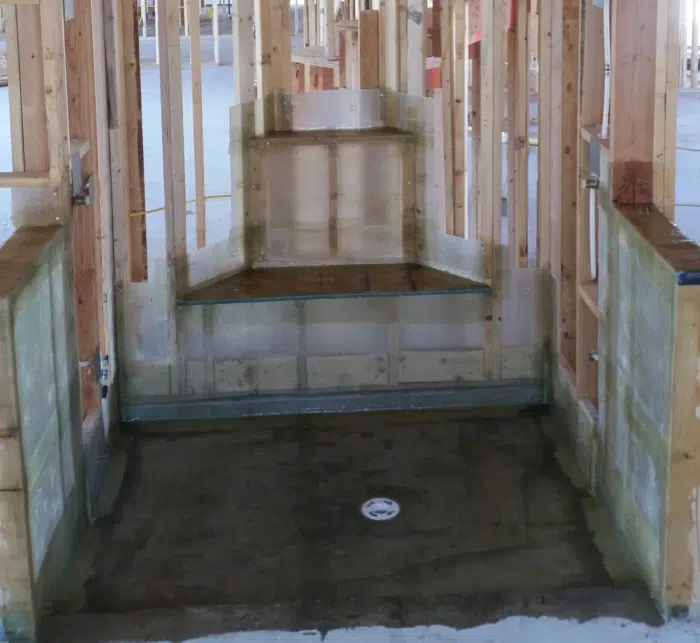
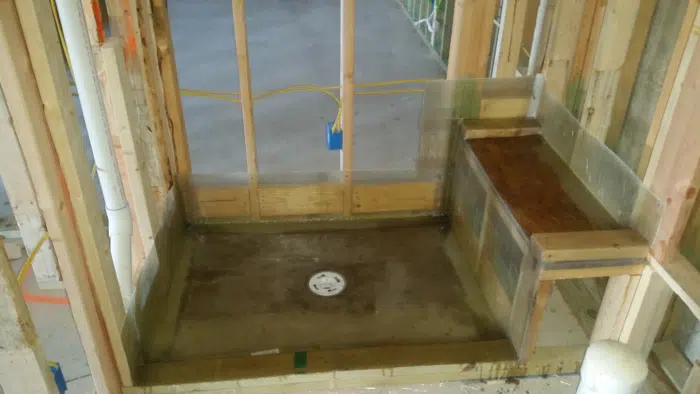
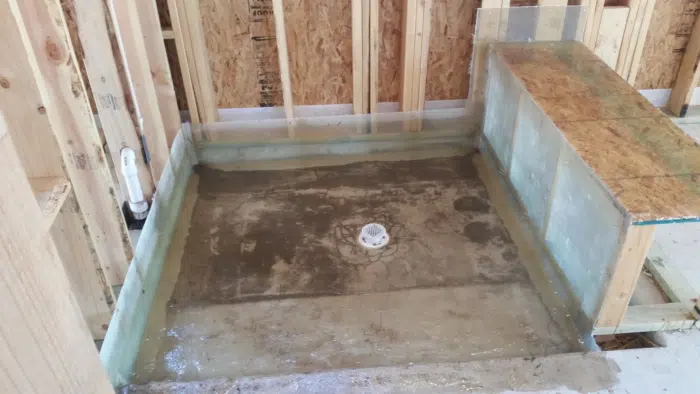
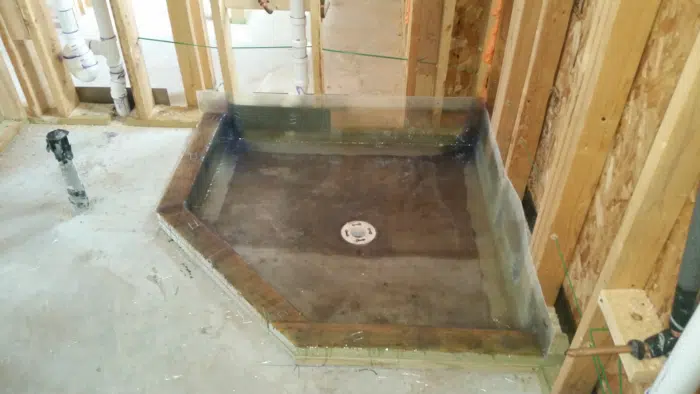
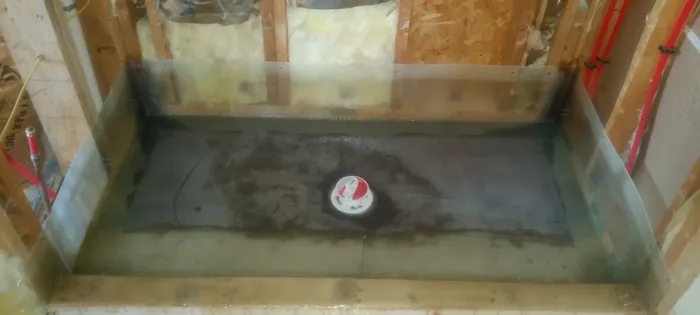
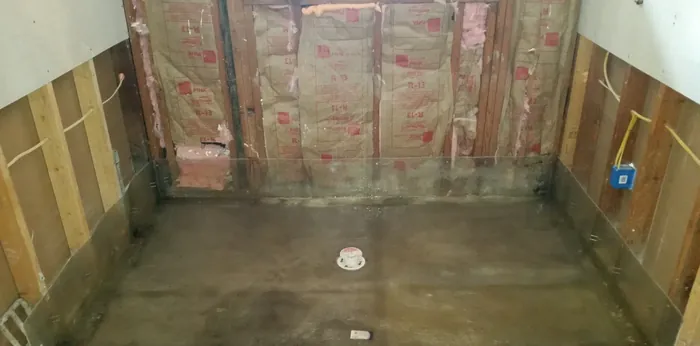
Pans, before the tile went on.
Every one of these is a membrane formed on site: sloped to the drain, carried up the walls and over the curb in one piece. This is what is under the finished floor.
Thinking about a job? Get an estimate or call 512-400-9008.